There comes a moment in every creator's life — usually around 11 PM, usually right after watching someone with a nicer setup — when the thought arrives fully formed: my content would be so much better if I just had the right gear. The browser tab opens. A ring light goes in the cart. Then a microphone. Then a camera that costs more than the first car you ever owned. And here is the uncomfortable truth that gear reviews will never tell you, because they earn their money from the cart and not from your results: most studio upgrades will not change your numbers at all, and the two or three that genuinely do are almost never the ones sitting in the cart at 11 PM.
This guide is the buying order that actually survives contact with reality. It rests on one simple observation about how audiences experience video: viewers will forgive almost everything except two things — they cannot hear you clearly, and they cannot see you clearly enough to follow what is happening. Everything else — the 4K, the bokeh, the RGB glow — is garnish. Below: what to buy first, in order, with honest price tiers; the gear traps that drain wallets while changing nothing; how to set up the room itself, which matters more than any single purchase; and the honest limits of what any studio can do for you. No promises that a light panel will make you grow. Just the truth about which purchases remove real friction, and which ones only remove money.
The uncomfortable truth: your camera is not the bottleneck
The phone in your pocket right now shoots 4K video with stabilization that would have cost a film crew five figures a decade ago. And yet the gap between your footage and the footage you admire is real — it is just not where you think it is. When creators compare their videos to the ones that look “professional,” they almost always blame the camera. But run the honest test: put a two-thousand-dollar camera in a dim, echoey room with a shaky hand, and put a phone in front of a big soft window in a quiet room on a stable mount. The phone wins. Every single time. The image pipeline of a modern phone is genuinely excellent; what no phone can fix is the physics of your room — not enough light reaching the sensor, hard reflections bouncing around the sound, movement the stabilization cannot fully erase.
This is why the late-night gear cart is such a trap. Cameras are exciting purchases with big numbers on the box. Lighting is a boring panel that glows. But your audience's experience is decided in a strict order: can they hear every word without strain, can they see your face clearly, is the frame steady enough to watch without fatigue. Resolution sits fourth — and most platforms compress it away before anyone sees it anyway. So the honest upgrade order is not camera-first. It is environment-first: light, then sound, then stability — and only then, if the content has earned it, the camera.
The real upgrade order: what to buy first
Think of your studio as tiers. Each tier removes one specific friction, and you should not buy the next tier until the previous one is genuinely solved. The whole honest setup costs less than most people spend on a single impulse camera — and it outperforms that camera on the only metrics that matter: clarity, comfort, and how often you actually film.
Tier 0 — the free tier: squeeze what you own (cost: $0)
Before spending a single rupee or dollar, wring the free tier dry. Film facing your largest window, never with it behind you — backlight turns you into a silhouette no sensor can rescue. Clean your phone's lens with a shirt sleeve; the number of “bad camera” complaints solved by ten seconds of wiping is honestly embarrassing. Put two meters of depth behind you instead of sitting against a wall — depth reads as quality to the human eye. Lock exposure by tapping and holding on your face so the brightness stops hunting mid-sentence. Film in the softest room you have, door closed. This tier alone lifts most beginners from “unwatchable” to “perfectly fine” — and if your content is not working at Tier 0, a purchase will not save it. The idea needs work, not the room.
Tier 1 — light you can control (the single biggest upgrade)
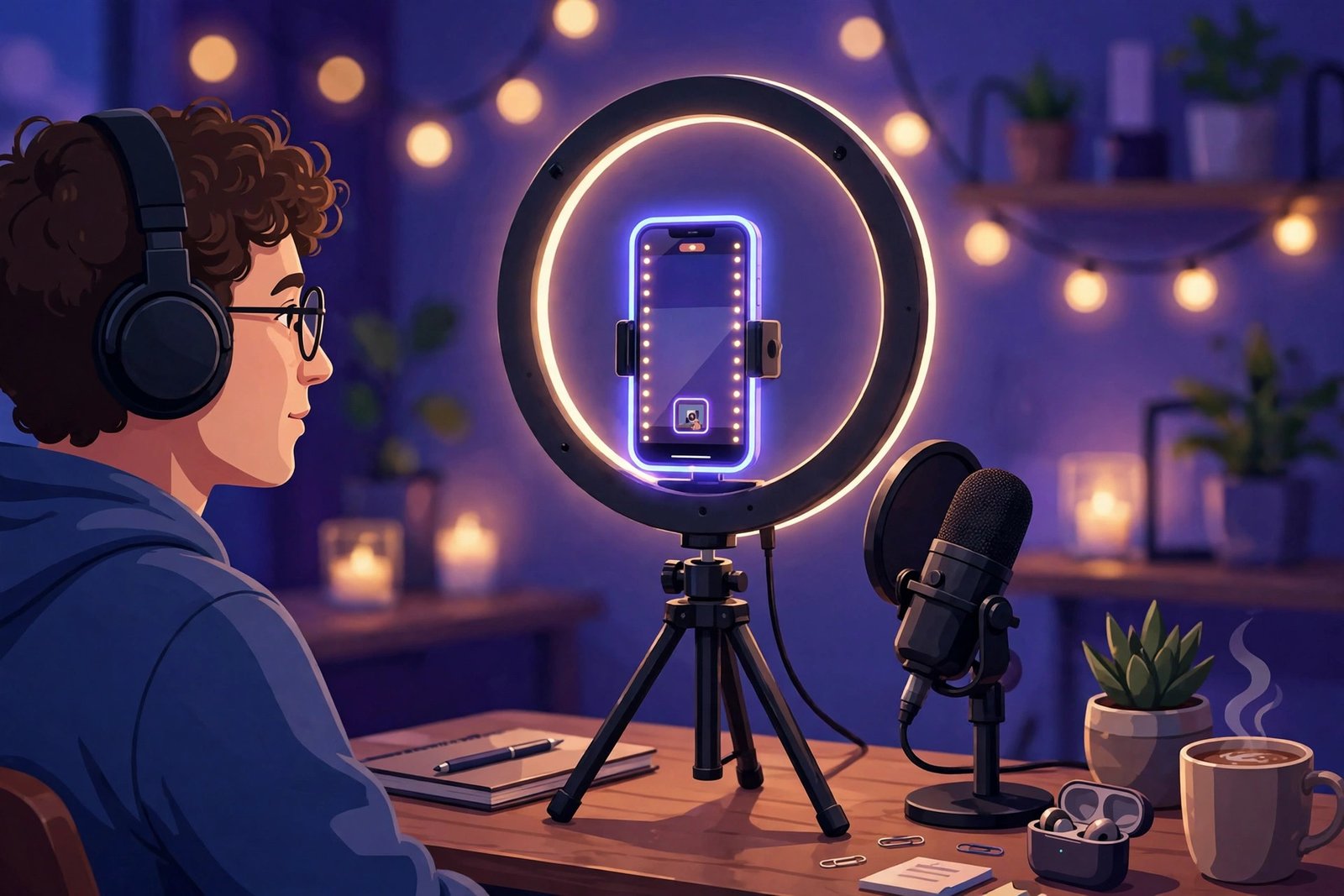
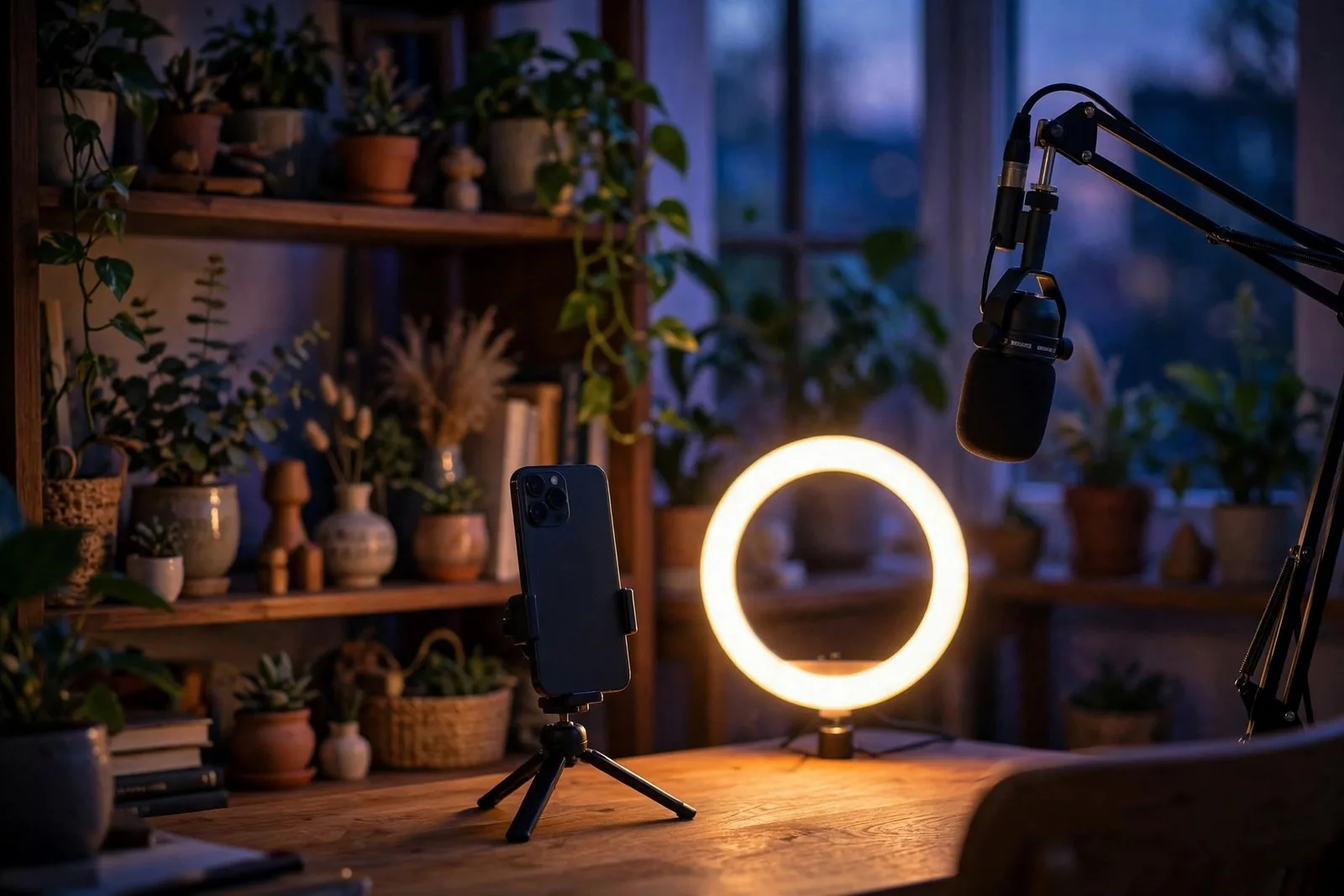
If you buy exactly one thing this year, make it controllable light. A window is beautiful and free, but it changes every twenty minutes and vanishes at night — and creators who can only film between 10 AM and 2 PM on sunny days simply film less, which is the real growth killer hiding inside a lighting problem. One affordable LED panel or ring light with adjustable brightness and color temperature removes the weather from your schedule entirely. Position it at roughly 45 degrees to your face, slightly above eye level, and move it close — a small light near you looks softer and more flattering than a big light across the room. Match its color to the room: warm in the evening, neutral in the day, so your skin tone does not fight the background. This single purchase does more for perceived quality than any camera upgrade under a thousand dollars, because it attacks the actual bottleneck: not enough photons reaching the sensor.
Tier 2 — sound nobody has to strain to hear
Here is a rule worth writing on the wall: viewers will watch 720p, but they will abandon bad audio in seconds. The human brain treats unclear speech as work, and nobody does unpaid work for a stranger's video. The free version of Tier 2 is acoustic honesty — film in the smallest, softest room you have, hang a blanket on the wall behind the camera, close the curtains, switch off the fan. Echo is the enemy and soft furnishings are free soldiers. When you do spend, spend small: a basic lavalier mic clipped to your shirt, or a budget USB mic on the desk, beats any camera's built-in microphone by a distance you have to hear to believe. And the oldest free trick in audio still wins: get the mic close to your mouth. Six inches of distance beats six hundred dollars of microphone, every time.
Tier 3 — stability and framing (the underrated tier)
Shaky footage creates a low-grade fatigue that viewers feel as “I don't like this video” without ever knowing why. And framing is free production value: camera at eye level, eyes on the upper-third line, a little headroom but not a cathedral of it. The purchase here is gloriously unsexy — a tripod or an adjustable stand that holds your phone exactly where you want it, every time, in five seconds. A simple adjustable phone stand on your desk turns filming from a production into a habit: phone in, record, done. No balancing the phone against a stack of books, no reshoots because it slid mid-take. Consistency of output beats quality of output in the early years, and nothing buys consistency like a setup with zero friction.
Tier 4 — the camera upgrade (only when the content has earned it)
Only now — with light, sound, and stability solved, and with months of consistent posting proving the format works — does a dedicated camera make honest sense. And even then, buy for your actual bottleneck, not for the spec sheet. If you film on the move, a compact gimbal camera like the DJI Osmo Pocket 3 solves stabilization and low-light in one pocketable device. If you film talking-head at a desk, a used mirrorless body with its kit lens will outperform any shiny new gadget at twice the price. The rule to remember: the camera is the last ten percent of quality and the first eighty percent of the budget. Buy it last, buy it for a named problem, and buy it used when you can — someone else's barely-touched upgrade is your discount.
What to skip: the gear traps
For every honest purchase there are three traps wearing its clothes. These are the ones that drain the most wallets while changing nothing:
- The 4K camera before the lighting. A better sensor in bad light produces a sharper image of bad light. Until Tier 1 is solved, every dollar spent on resolution is a dollar spent on the fourth priority while the first three are broken.
- RGB everything. Colored backlights look exciting in unboxing videos and distracting in actual content. One neutral key light and one warm practical lamp will make you look better than a rainbow ever will — and your viewers came for you, not your wall.
- The expensive microphone in an untreated room. A sensitive condenser mic in a bare, echoey room does not give you studio sound; it gives you a high-fidelity recording of your room's echo. Treat the room first (blankets are free), then upgrade the mic.
- The green screen, before you need one. Keying looks easy on YouTube and eats hours in practice — lighting the screen evenly, fixing edge spill, re-shooting when it fails. A clean real background beats a mediocre virtual one, and it costs nothing.
- The full kit on day one. Buying everything at once skips the only education that matters: learning which friction is actually stopping you. Buy tier by tier, and let each purchase prove itself before the next one.
Notice the pattern: every trap optimizes the part of the image your audience notices least, while ignoring the part they notice most. Gear marketing sells specifications; audiences buy comfort — can I hear you, can I see you, does this feel steady and intentional.
Set up the room, not just the gear
Here is the secret the gear channels never cover, because you cannot put it in a cart: the room is the studio. A fifty-dollar light in a good room beats a five-hundred-dollar light in a bad one, because the room decides what the light has to work with. Four room moves that cost nothing:
- Depth behind you. Sit at least two meters from the wall behind you. Depth lets the background fall softly out of focus and instantly reads as “professional,” even on a phone.
- Layers, not clutter. A plant, a shelf with books, one warm lamp in the background — three layers at three different distances. Clutter is ten things at the same distance; depth is three things at three distances.
- One warm practical light in frame. A desk lamp glowing softly behind you adds warmth and dimension that no key light can fake, and it costs whatever lamp you already own.
- The always-ready corner. Leave the stand up, the light plugged in, the mic on the desk. Setup friction is the silent killer of consistency — and consistency is the whole game.
That last point deserves emphasis, because it is the highest-leverage idea in this entire guide: the five-minute rule. If it takes more than five minutes to go from “I have an idea” to “I am recording,” you will film less — not because you are lazy, but because friction compounds against motivation every single day. The best studio is not the most expensive one. It is the one that disappears: sit down, press record, talk. Everything you buy should be judged against that standard. If a purchase adds setup time, it had better remove a bigger problem.
The honest limits
Honest advice names its edges, so here they are. No studio fixes weak ideas — a beautiful room delivering a boring thought is still a boring video, and audiences leave faster when the packaging promised more than the content delivered. No platform scores your production value; the ranking measures whether people stay, save, and share, and a phone video with a great hook beats a cinema camera with a weak one every day. The returns diminish fast past the tiers above — the jump from Tier 0 to Tier 2 is enormous, and the jump from Tier 2 to a full pro rig is barely visible to anyone but you. And the most expensive trap of all is procrastination by purchase: the feeling of progress that comes from buying gear is real, and it is the exact feeling that posting consistently gives you — one of them is free, and it is not the gear. If you want a second opinion on whether your content or your setup is the bottleneck, content analysis looks at your actual posts and tells you which of your videos held people and which lost them — because the answer is in your retention curves, not in your shopping cart.
Frequently asked questions
How much should a beginner actually spend on a studio?
Nothing for the first month — run Tier 0 and prove you will actually post. Then roughly $30–80 total: one adjustable light and one phone stand or tripod. Add a $20–40 mic only when you are posting weekly and the room is treated. Everything beyond that waits until the content has an audience telling you, through saves and comments, that it deserves better production. Spending in this order means every dollar removes a real, named friction.
Phone or dedicated camera — which should I start with?
The phone, without hesitation. Modern phones out-resolve what social platforms deliver after compression, their autofocus is excellent, and — the decisive factor — the phone is always with you, which means you film more. A dedicated camera earns its place only when you can name the specific problem it solves: real low-light work, optical zoom, or hours of continuous recording. “Better quality” is not a named problem; it is a wish.
Ring light or softbox — does it actually matter?
Less than either one's marketing suggests. A ring light gives even, flattering frontal light with the characteristic round catchlight in the eyes — great for beauty and talking-head, and it often doubles as a phone mount. A softbox or LED panel gives more directional, dimensional light that sculpts the face with shape and shadow — slightly more “cinematic.” For most creators the honest answer is: buy whichever adjustable, dimmable one fits your budget and space; position it correctly (45 degrees, close, eye level); and you will outperform 90% of creators who bought the “right” light and pointed it at the ceiling.
When is it honestly time to upgrade my gear?
Three tests, and all three must pass. One: you have posted consistently for at least two to three months, so the bottleneck is the setup, not the habit. Two: you can name the specific friction — “my evening videos are too dark” is a lighting problem worth solving; “I want it to look more professional” is not. Three: the content is working — real saves, real comments, real returning viewers — so the upgrade multiplies something instead of decorating nothing. Fail any test and the honest move is to keep creating, not keep shopping. And if you are weighing growth tools while you are at it, Virello's pricing keeps the honest analytics on the free plan — the scoreboard should never sit behind a paywall.
The bottom line
Your studio is not a shopping list; it is a friction-removal machine. Light you can control, sound nobody strains to hear, a frame that stays put, a corner that is always ready — that is the whole honest setup, and it costs less than the camera you were about to buy at 11 PM. Buy in order, skip the traps, set up the room, and judge every purchase by the five-minute rule. Then get back to the part no purchase can do for you: the thinking, the hook, the next post. See how Virello works — paste a post, let the ten-agent growth loop find what is actually holding it back, and spend your gear budget only on problems your own data confirms.