TikTok looks like a lottery from the outside. A stranger with twelve followers posts a video from their kitchen and wakes up to a hundred thousand views, while a creator who has posted every day for a year watches their best work stall at four hundred. It is easy to conclude that the platform is random, rigged, or both — and that conclusion is exactly what keeps most new creators stuck, because it makes the only honest response look pointless. Why bother improving if it is all luck anyway?
It is not luck. It is a test, and it is the same test every single time: a stranger is shown your video, and in the first three seconds they decide whether to stay. Then TikTok watches what happens next — how long they stay, whether they save it, whether they share it, whether they come back for more — and shows the video to a few more strangers who look like them. That is the whole machine. There is no secret handshake, no magic posting hour, no hashtag that rescues a video nobody wants to finish. This guide is the honest version of how that machine works in 2026, what new creators should actually do about it, and what to ignore — including the parts of TikTok advice that sound exciting and change nothing.
How TikTok actually decides what to show
Every video you post gets the same fair trial, and that is the most important thing a new creator can understand about TikTok. The platform does not check your follower count first and decide you are too small to bother with. It takes your video and shows it to a small test audience — a few hundred people whose past behaviour suggests they might care about the topic — and then it watches. If those people watch to the end, save it, share it, or leave a real comment, the video gets shown to a bigger group. If they swipe away in two seconds, the test ends there. Your twelfth video gets the same trial as your first, and your first video gets the same trial as a creator with a million followers. The follower count matters far less on TikTok than on any other platform, and that is genuinely good news for you.
The numbers TikTok actually weighs are the ones that describe real human behaviour, in roughly this order. Average watch time and completion rate come first: did people stay, and how much of the video did they finish? A 30-second video that most people watch to the end beats a 3-minute video that most people abandon at second eight, every time. Saves come next, because saving is the strongest signal that a video was useful — people do not save things they merely liked. Shares after that, because a share means someone staked a little of their own reputation on your video by sending it to a friend. Comments count when they are real — a conversation in the replies tells the platform that the video started something, while a flood of single-emoji comments tells it nothing at all. Rewatches are the quiet superpower: a video people watch twice is a video the platform wants to show more, which is why the best TikTok advice is often to make videos short enough to rewatch.
What TikTok does not reward, no matter how many gurus insist otherwise, is equally worth knowing. Hashtags do not rescue a weak video; they help the platform categorise a good one, which is a small and boring job. Posting ten times a day does not multiply your chances; it multiplies your chances of posting ten mediocre videos. Trending sounds do not carry a video — they give it a little context, and a video that only works because of the sound underneath it is a video that was never really working. And follower count, again, is the number people obsess over and the platform cares about least in the test phase. All of this points to the same practical conclusion: your job is not to game the test. Your job is to pass it, and passing it means making videos that strangers actually finish.
The first three seconds are the whole game
If the test audience decides in three seconds, then the first three seconds are not the introduction to your video — they are the video, as far as survival goes. Most new creators waste them. They open with context ('So today I wanted to talk about...'), with a greeting ('Hey guys, welcome back'), or with a vague promise ('You won't believe this'). All three are invitations to keep scrolling, because none of them tells a stranger why this video, right now, is worth their next thirty seconds. The viewer owes you nothing — not their attention, not their patience, not a second chance. The hook is the only place you get to earn it.
A working hook does three things at once, and you can check any opening against them in about ten seconds. First, it names the specific thing the video delivers — not the topic, the payoff. 'Budget tips for beginners' is a topic. 'The one budget mistake that cost me $400 last month' is a payoff, and a stranger can feel the difference instantly. Second, it creates a small open loop: a question the viewer now wants answered, a claim they want to check, a result they want to see. Third, it matches the video that follows — the fastest way to kill a video is a great hook attached to a video that never delivers on it, because viewers feel cheated, they leave, and the platform notices. If you want the deeper craft of this, the two-second hook guide breaks down the exact formulas, but the short version is this: be specific, be honest about what is coming, and say the interesting thing first.
Here are four hook patterns that work for new creators, with real examples you can steal the shape of, not the words:
- The costly mistake: 'I wasted six months growing the wrong way — here is the one thing I would change.' It works because a mistake with a price tag is instantly credible.
- The specific result: 'This 20-second trick doubled my saves.' It works because a number makes a vague promise concrete — but only use numbers you can honestly defend.
- The contradiction: 'Everyone says post every day. I posted three times a week and grew faster.' It works because it challenges something the viewer already believes, which makes them stay to see if you are right.
- The direct question: 'Why does your TikTok stall at 200 views?' It works because it names the viewer's actual problem, out loud, in their own words.
One practical habit makes all of this easier: film three openings for every video, and pick the best one before you film the rest. It takes five extra minutes and it is the highest-leverage five minutes in the whole process, because the opening is the only part of the video that decides whether the rest of it ever gets seen. If none of the three openings is good, the video is not ready — and knowing that before you film the whole thing saves you the hour you would have spent polishing a video nobody was going to watch.
Formats that work for brand-new creators
New creators usually ask the wrong question about TikTok. They ask what niche they should pick, as if the right niche were a lottery ticket, and then they freeze, because every niche looks taken and every choice feels permanent. The better question is what format you can repeat. A format is a shape you can fill with a different idea every time — and formats are what actually build an audience, because they teach strangers what to expect from you. A viewer who liked your 'one mistake I made' video knows exactly what to expect from your next one, and that expectation is what turns a single view into a follow.
Five formats work especially well for creators starting from zero, because none of them requires an audience, a budget, or permission from anyone:
- The honest tutorial: one specific thing, done well, in under a minute. Not 'how to grow on TikTok' — 'how to write a hook in 30 seconds'. Specificity is the whole trick: a tutorial that helps one person properly beats a tutorial that vaguely helps everyone.
- The mistake, with the receipt: what you got wrong, what it cost you, and what you do now instead. Audiences trust creators who show their work, including the parts that did not work — and mistakes are the most underused idea source in existence.
- The before and after: the messy first attempt next to the improved version, with the one change that made the difference named out loud. Transformation is TikTok's native language.
- The 'I tried it so you don't have to': you test a piece of advice, a tool, or a trend, and report honestly on what happened. It works because you are doing the work the viewer was not going to do — and honesty about a bad result builds more trust than a good one.
- The reply video: a comment from a real viewer, answered on camera. This is the easiest format on the list and the most powerful for a small account, because it turns your smallest audience into your content — and every reply video is also a reply to a real person, which is how a community actually starts.
Pick one format and run it for your first twenty videos. Not two formats, not five — one. Twenty videos in one format is enough to get genuinely good at it, enough for the audience to recognise it, and enough data to know whether it works for you. If after twenty videos the format feels dead, you have learned something real and you switch with evidence. If you switch formats every three videos, you will never know whether the format failed or you simply never gave it a chance. Consistency of shape is what makes a small account legible to strangers — and legibility is what a follow actually is: a stranger deciding they know what they will get next.
Your filming setup: the honest minimum
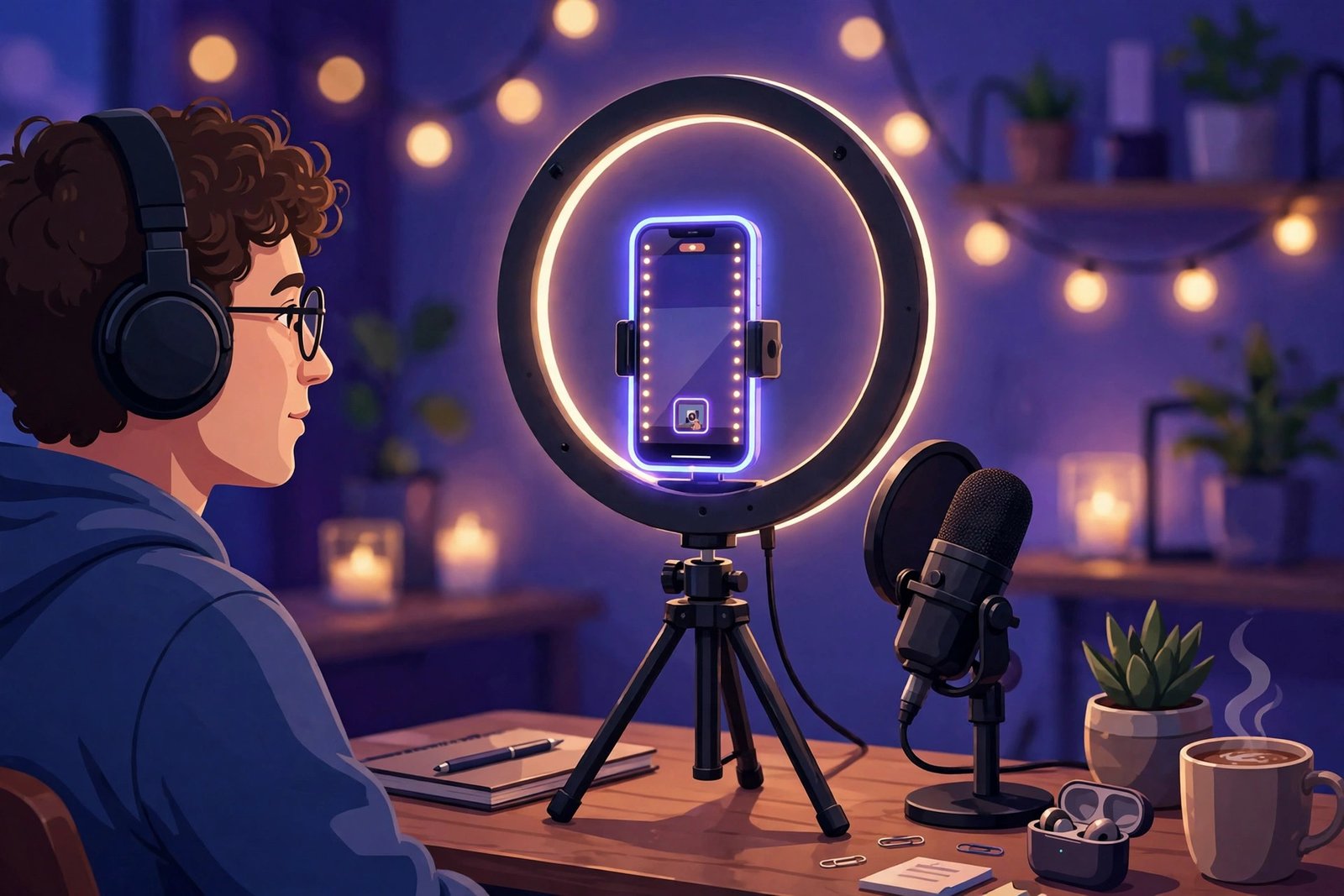
TikTok is the most forgiving platform on earth about production quality, and that is a genuine advantage for new creators — but 'forgiving' does not mean 'anything goes'. The phone in your pocket shoots video that is more than good enough, and the creators who tell you that you need a camera before you need an audience are selling you something. What your phone cannot fix is the physics of your room: not enough light reaching the sensor, sound that echoes, a frame that wobbles. So the honest setup is boring and cheap, and it has three parts.
First, light: film facing your largest window, or put one affordable light in front of you at roughly 45 degrees, slightly above eye level. A window is beautiful and free, but it changes every twenty minutes and vanishes at night — and creators who can only film between 10 AM and 2 PM on sunny days simply film less, which is the real growth cost hiding inside a lighting problem. Second, sound: film in the smallest, softest room you have, and get the phone close to your mouth. Viewers will watch shaky 720p, but they abandon bad audio in seconds, because unclear speech feels like work and nobody does unpaid work for a stranger's video. Third, stability: your phone needs to stay exactly where you put it. A simple adjustable stand like the LISEN height-adjustable cellphone stand on your desk turns filming from a production into a habit — phone in, record, done — and a steady vertical frame is the difference between a hook that lands and one that wobbles away.
When, honestly, should you spend more? Three tests, and all three must pass. You have posted consistently for at least two months, so the bottleneck is the setup, not the habit. You can name the specific friction — 'my walking videos are unusably shaky' is a real problem worth solving; 'I want it to look more professional' is not. And the content is already working, so the upgrade multiplies something instead of decorating nothing. If you do pass all three tests and you film on the move, a pocket gimbal camera like the DJI Osmo Pocket 3 Creator Combo solves stabilisation and low light in one device you can carry anywhere. If you film talking-head at a desk, you do not need it — your phone, a stand, and a window are already the whole honest setup, and the money is better spent on the one thing no purchase can buy: more videos.
Posting rhythm: consistency beats volume
The most common TikTok advice for new creators is to post three times a day, and it is also the advice most likely to make a new creator quit. Three videos a day is a full-time job, and a new creator doing it for two weeks and then vanishing for a month has posted less, in total, than the creator who posted three times a week for a year. The algorithm does not reward bursts; it rewards a pattern it can learn from. A steady rhythm of three to five videos a week, sustained for months, beats a heroic fortnight followed by silence — and it beats it by a distance that is not close.
The practical version is simple. Pick the days you can genuinely sustain — Monday, Wednesday, Friday, for example — and treat them as appointments, not aspirations. Batch where it helps: one filming afternoon can produce a week's worth of videos in a single format, and the batching playbook shows the exact four-hour workflow. Post when your audience is actually awake, not when the gurus say everyone should post — your own analytics will tell you, and the posting-times guide explains how to read them honestly. And give every video the full week before you judge it: saves and shares trickle in for days, TikTok re-tests content on day three and four, and a video that looked dead on Tuesday has quietly doubled by Sunday more often than anyone admits.
The part of the rhythm that most new creators skip is what happens between posts, and it matters more than the posting schedule itself. Replies are not admin — they are content, and they are the cheapest growth on the platform. Answer comments on camera with the reply-video format. Ask a question at the end of a video and actually respond to the answers. A creator with 200 followers who answers every comment has a community; a creator with 20,000 followers who answers nobody has an audience that is already leaving. The posting schedule gets you seen. The replies get you remembered.
Reading your numbers without lying to yourself
TikTok gives you more data than any new creator needs, and the skill is knowing which three numbers to look at and which ones to ignore. Average watch time tells you whether people stayed — the single most important number on the platform, because everything else follows from it. Saves per view tells you whether the people who stayed thought it was worth keeping, and a video with a high save rate and a low view count is a hidden gem with a distribution problem, not a failure. Follows per view tells you whether the video made anyone curious about you — a video with views but no follows entertained strangers without giving them a reason to stay. Everything else is decoration: total views without context, likes without saves, and your own follower count, which is the number people obsess over and the number that tells you least about whether the next video will work.
Run a 20-minute review once a week and keep it brutally simple. Sort your last ten videos by saves per view, not by total views. Find the one that outperformed the rest and ask, in one sentence, what it did differently — the hook, the format, the topic, the length. Then find the one that underperformed most and name its cause in one sentence too. Write both sentences down. That is the entire review, and it is worth more than an hour of staring at graphs, because it turns numbers into decisions: more of the first thing, less of the second. If you want the full method, the analytics guide covers the weekly routine in detail — and AI content analysis reads your real retention data and tells you where viewers actually left, because the answer is in your own numbers, not in anyone's guess.
One warning about the numbers: do not compare your videos to your one viral outlier. A video that got 100,000 views because the platform tested it on a huge audience is not your baseline; it is a lottery ticket that happened to land. Your baseline is your last ten videos in the same format, averaged. Comparing a normal video to your best-ever video is not analysis — it is a way to feel bad on purpose, and it leads creators to abandon formats that were actually working.
What NOT to do on TikTok
The honest playbook would be incomplete without the list of things that feel like shortcuts and function as traps. Every one of these is common, every one of them is sold to new creators daily, and every one of them makes growth harder, not easier.
- Do not buy followers or engagement. Fake likes do not fix a hook problem, they poison your analytics, and they teach TikTok to show your content to the wrong people — the bots and the disinterested. Your account pays for it long after the post is forgotten, and the numbers you bought will never become a real audience.
- Do not join follow-for-follow pods. A hundred followers who never watch anything are worse than ten who do. They drag down every rate the platform measures, and the platform concludes, correctly, that your content does not hold people.
- Do not chase every trend. A trend that has nothing to do with your format is a video your audience did not ask for, and one trend video that flops teaches the platform nothing useful about who you are for. Use a trend only when it fits the format you already run — otherwise it is noise.
- Do not repost the same video hoping for a different result. TikTok already tested that video, and the audience already answered. A repost with a new hook and a new opening is a second attempt with the lesson applied; an identical repost is the same test with the same answer.
- Do not delete a video after two hours. You are deleting unfinished data. The video is still being tested, saves are still trickling in, and you will never know whether it would have recovered — which is exactly how good videos get deleted for no reason.
- Do not copy a viral video shot for shot. Audiences can tell, the original creator's audience can tell, and a copy teaches you nothing about what your own audience wants. Study what worked — the hook, the structure, the length — and build your own version of the shape, not the words.
Frequently asked questions
How many followers do I need before TikTok takes me seriously?
None. Every video gets the same test audience whether you have twelve followers or twelve thousand, and the platform judges the video, not the account. Follower count helps later — it gives each video a warm starting audience — but it is never the reason a new creator's first videos stall. The hook is.
Should I really post three times a day?
No. Three to five videos a week, sustained for months, beats a two-week burst followed by silence. The right number is the one you can sustain for six months without burning out, and if that number is three a week, that is a strong, honest pace. Volume only helps when quality holds — and for a new creator, quality holds at three good videos a week far more often than at twenty-one rushed ones.
Do hashtags matter on TikTok?
A little, and in a boring way. Three to five relevant hashtags help TikTok categorise your video so the test audience is the right one — 'budgeting tips' reaches people who watch budgeting videos, which is the whole job. Thirty hashtags, trending tags that have nothing to do with your video, and tags copied from viral videos do not help, and the irrelevant ones actively hurt by sending your video to the wrong test audience.
How long before I see real growth on TikTok?
Honestly: give it thirty to sixty days of consistent posting — three to five videos a week in one format — before you judge anything. That is enough videos to have a real baseline, enough time for the platform to learn who your videos are for, and enough practice for your hooks to get genuinely better. Some creators see a video take off in week two; most see slow, uneven growth with one or two videos doing the heavy lifting. Neither is a promise. The only honest guarantee is this: if you post consistently in one format and study your own numbers every week, you will know, by day sixty, whether the format works — and that knowledge is worth more than any viral spike. And if you want a second pair of eyes on which of your videos actually held people, the Content Analysis agent reads your real data — while Pro and Business pricing keeps the honest analytics on the free plan, so the scoreboard never sits behind a paywall.
The bottom line
TikTok in 2026 is not a lottery, and it is not a conspiracy against small creators. It is a test that every video gets, judged on whether strangers stay, save, and come back — and a new creator's entire job is to pass that test a little better each week. Pick one format and run it for twenty videos. Open with the specific payoff, not the context. Film with the phone you already own, a window, and a stand that keeps the frame still. Post three to five times a week, answer every comment, and review your numbers once a week with the three numbers that actually matter. Ignore the bought followers, the trend-chasing, the posting ten times a day — all of it costs more than it pays, and the bill arrives in your analytics. Then make the next video, which will be better — not because you got lucky, but because you now know one more true thing about the strangers you are making things for. how Virello works — paste a post, let the ten-agent growth loop find what is actually holding it back, and spend your energy on the next video instead of guessing at the last one.